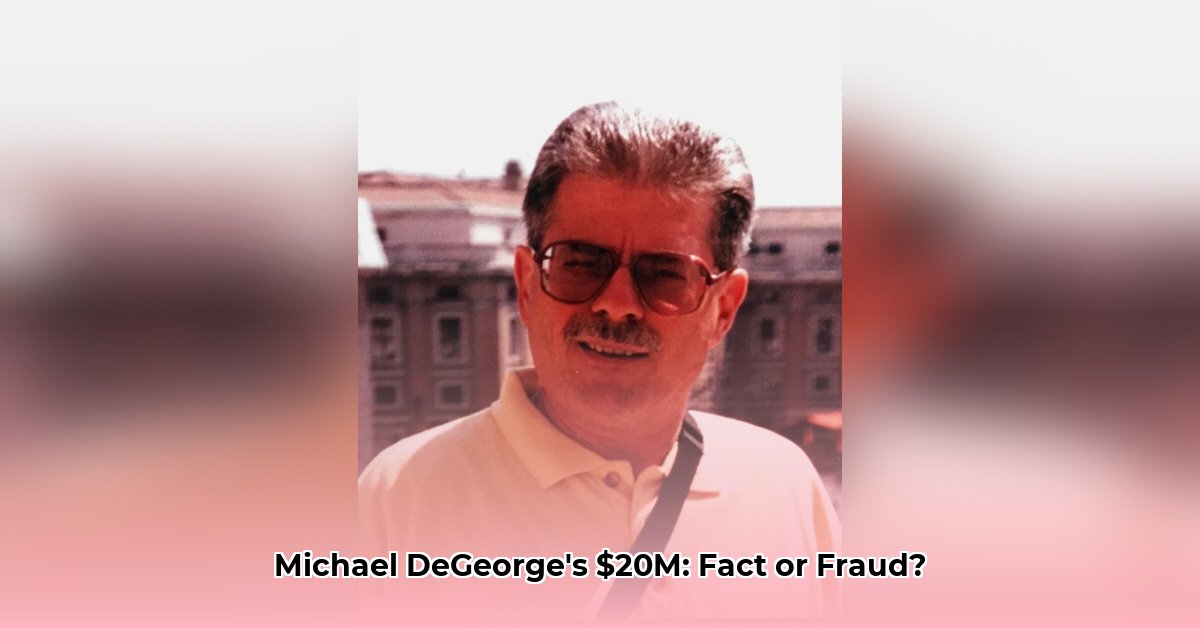
A Tale of Two Fortunes: $20 Million or Alleged Fraud?
The purported net worth of Michael DeGeorge presents a compelling financial enigma. Public pronouncements suggest a substantial $20 million fortune amassed through entrepreneurial endeavors and philanthropic activities. However, this narrative clashes sharply with serious allegations of insurance fraud, casting doubt on the accuracy of the claimed wealth. This investigation examines the conflicting accounts, analyzing the evidence and exploring the broader implications for financial institutions and the public.
One account portrays DeGeorge as a successful entrepreneur and generous philanthropist, justifying a $20 million net worth. However, this claim lacks concrete supporting evidence, such as independently audited financial statements or detailed investment records. The absence of verifiable documentation leaves the $20 million figure unsubstantiated and open to considerable skepticism. But how often do we see truly verifiable documentation for such claims, especially concerning HNWIs (High Net Worth Individuals)?
Conversely, DeGeorge faces serious allegations of insurance fraud, involving approximately $300,000 in allegedly fraudulent claims. An investigation by AIG reportedly uncovered inconsistencies in submitted documents, including metadata discrepancies in supporting photographs--evidence suggesting potential manipulation. This raises critical questions about the veracity of the $20 million claim. Could this be a sophisticated attempt to project a false image of wealth?
Weighing the Evidence: Unraveling the Discrepancies
The contrasting narratives present a significant challenge in determining DeGeorge's actual net worth. The $20 million claim relies heavily on self-reported information, lacking independent verification. In contrast, the insurance fraud allegations are supported by an investigation that uncovered substantial evidence of potentially criminal activity. This stark contrast necessitates a critical examination of the available evidence.
The fundamental difficulty stems from the inherent opacity surrounding the finances of high-profile individuals. Without transparent financial records, reliably assessing net worth becomes extraordinarily difficult. DeGeorge's case serves as a stark reminder of this challenge. How can we reconcile a self-reported $20 million fortune with credible allegations of significant financial misconduct? The discrepancy demands a thorough investigation relying on verifiable data.
Beyond DeGeorge: Broader Implications
The implications of this case extend far beyond DeGeorge's personal finances. Several key players are impacted:
Financial Institutions: This situation highlights the need for enhanced due diligence procedures to ensure thorough vetting of individuals and businesses before extending services or credit. Failing to do so exposes institutions to significant financial risk and reputational damage. Do current industry standards adequately mitigate such risks?
Insurance Companies: Stronger claim verification processes are paramount to prevent future occurrences of alleged fraud. The adoption of advanced technologies, including AI-powered fraud detection systems, might enhance the accuracy and efficiency of claim assessments. What innovative technologies can be implemented to improve the detection and prevention of insurance fraud?
Law Enforcement: Thorough investigation of financial crimes is essential. Refined investigative techniques, leveraging technological advancements, are crucial for effective detection and prosecution of fraudulent activities. What are the current limitations of law enforcement in effectively combating financial crime, and how can these be overcome?
The Public: The public should approach extraordinary claims of wealth with healthy skepticism, particularly when lacking supporting evidence. Critical thinking and reliance on verifiable information from credible sources are crucial in judging the validity of such assertions. How can individuals effectively protect themselves from similar fraudulent schemes?
How to Verify High-Net-Worth Individual Net Worth Claims Amidst Fraud Allegations
The DeGeorge case underscores the difficulty of accurately assessing the net worth of HNWIs, especially when fraud allegations exist. Verifying such claims demands a meticulous, multi-faceted approach:
Leverage Public Records: Begin with accessible public information like property ownership, business registrations, and court filings. Discrepancies between these records and stated net worth immediately raise red flags.
Analyze Financial Statements: Obtain and verify independently audited financial statements from reputable firms. However, remember these documents can be manipulated, requiring careful scrutiny.
Examine Tax Returns: Explore the availability of tax return data through legal channels, which may reveal information about income, assets, and deductions.
Gather Corroborating Evidence: Seek witness testimonies and corroborating evidence, acknowledging potential biases and self-interests.
Consult Expert Opinions: Involve financial experts and forensic accountants to provide independent analysis and assessment of the accumulated data.
The comparison of publicly available information with DeGeorge's $20 million claim highlights substantial inconsistencies. These discrepancies necessitate careful analysis to determine whether these are results of undisclosed assets, deliberate misrepresentation, or simply inflated self-reporting.
Independent verification is crucial; reliance solely on self-reported figures invites manipulation. Cross-referencing multiple sources and employing independent experts strengthens any net worth estimation significantly. Forensic accounting plays a vital role in fraud investigations, utilizing specialized techniques to unearth hidden assets and identify patterns indicative of fraudulent activity. Investigations must always adhere to legal and ethical standards, respecting privacy rights and data protection laws.
The DeGeorge case serves as a cautionary tale, highlighting the vulnerabilities within our financial systems and the importance of thorough investigation and critical analysis when evaluating claims of substantial wealth. The ongoing investigation underscores the need for vigilance and a focus on verifiable evidence.